Tuesday, March 5, 2013

Farming With Jesus

Ever since Tabitha Schulke's story ran in Thursday's Oregonian,
http://www.oregonlive.com/pacific-northwest-news/index.ssf/2013/02/monmouth_mom_faced_with_terrib.html 

 I've been thinking about her and the questions posed by today's text from Luke 13. In Jesus' own day, the default questions were:


1) Why did this happen?

2) Who is to blame?

3) What is this all for?

4) When will the bad people finally get what's coming to 'em?

Why do bad things happen to good people?

But that's really a stupid question. Why do bad things happen at all? To anyone? But then, we can ask those questions 'til we are blue in the face. And I can ask another "w" question: Where do all of those other questions get us in the first place? Nowhere. Wrong questions. Wrong letter of the alpahbet.

Instead of "w" for why, I like "h" for how. Now that life is this way, whatever way it is, HOW do we live with this, whatever "it" is? Tabitha Schulke and her mother could certainly waste their entire lives asking why this gorgeous, loving, 18-year-old got some lethal infection that took her legs in order to save her live. But because there is something else in Tabitha's heart and soul, I predict they don't. I predict they ask the question, "How do we live with this?" And then they proceed to do so: live with it.

After questions about human disasters and loss of life, Jesus told a story in Luke 13 about a barren fig tree. And a vineyard owner who wants the barren tree taken out. Now. But there's a hopelessly optimistic gardener who has some sort of miracle grow fertilizer: manure.

Until this week, I've heard that story putting God in the place of the landowner. And Jesus in the place of the gardener... Which means that Jesus' whole purpose is protecting us from the God who wants us out of the picture--and who could fire the gardener at any time and finally carry out three-strikes justice. So much for Jesus' revealing the heart of steadfast love... Or...

Maybe the story works better if the "vineyard owner" equals the way much of the world works: Three strikes, you're out. You've had your chance. Time's up. No hope, no forgiveness, no future. Buzz off!

So maybe we could see God as the crafty gardener who has a sly smile on his face and says, "I got a plan. I got this miracle-grow stuff. I don't need three years, just one. I'll bet the whole farm, the entire future on my "fertilizer", because I know that all it needs is just one chance to work. Just one."

Interesting. Cause that makes Jesus Messiah the manure, doesn't it? The natural, organic, life-giving substance that the gardener (God) has been willing to stake everything on, you and me included.

"For He hath made Him to be sin for us who knew no sin:  that we might be made the righteousness of God in Him."   2 Cor. 5:21 KJV. 

That's some high quality manure. Gotta love that divine nitrogen cycle. 

Back up to Luke 13.  After the fig tree parable, Jesus is met by a woman who has been beset by a crippling condition that has kept her hunched over and contorted for 18 years, same span as Tabitha Schulke's entire life to date.   Then, instead of going down every rat and rabbit hole with questions of why and who's to blame, who's at fault, Jesus does something with that fertilizer of steadfast love and compassion.

"Woman, you are set free from your ailment,"  Jesus says according to Luke 13.  Nice.  She straightens up.  Fixed.  Cured.  Fairytale world of the Bible. 

But that was then and this is now...  Does that kind of miracle ever happen today?  I think so...

Tabitha Schulke will never wake up some morning and find her amputated legs and feet restored. But she, like the woman Jesus healed on the Sabbath, has been freed of her ailment. She is not stuck in the death spiral of asking why. She and her Mom are busy answering the question "how". The fertilizer of Christ has been spread on their hearts.

My friend Karen whose father was KIA in Vietnam in 1966 when she was nine will never look across the room and see her father standing there alive.  Not until the next life, anyway.  Karen, along with her sibs, has lived with the "ailment" of his death nearly all of her life.  In pain, denial, anguish and confusion to be sure, her life has taken turns and been transformed into a life of compassion, understanding, healing, comfort and hope for so many people who have also suffered great loss.  Gold star wives, parents, children, siblings.  Communities and households shattered by the horrible death of battered children.  Parents who lost loved ones in the 9/11 terrorist attacks.  Countless readers around the globe.    

There's a common ingredient here:  the miracle growing stuff of the parable.  Tabitha's life and story are yet to be written, mostly.  Yet I predict that her loss becomes a source of life and grace according to a script none of us could have written.  A miraculous product exists:  grace around the roots of our barren fig trees.    

A wily gardener knew what he was doing back when.  Still does.   

Jesus called on his hearers to repent, to turn around to see the kingdom of God right before them, right beside them, right behind them.  He calls them to see life where others see only death; to see a way forward where others see only dead ends.

Can you smell the fresh fragrance? Life, I tell ya. Life. Happy farming with Jesus!

There is a way to live with this, whatever "it" is. Fertilizer's guaranteed. Amen.

Pastor Roger

Friday, February 15, 2013

Guns 'n Roses Questions

For every specific instance put forth as a general argument pro or con, there is another just as convincing for the opposite view. In a local discussion, a commentor put forth some numbers that are startling. In neighboring Washington State, the number of gun deaths now exceeds the number of motor vehicle deaths by a significant margin.
Having a gun in the home of the Newtown, CT, shooter did not keep that young man's mother safe. She was killed with her own gun. Oscar Pistorius' girlfriend, as the allegations now stand, wasn't safer because her lover had a gun in the home--although to be fair, I don't know how many would-be home invaders Mr. Pistorius may have fought off with that gun in the past. Three a day? Any at all?

I always wonder... would the (alleged) killers in either of the above cases have killed the women, would depressed and angry fathers have murdered their wives and their own children, if they'd had to actually touch them, hold them down long enough to shove the knife blade in several times. Does that few feet of remoteness, that powerful extension of self and self-will afforded by firearms make any difference? Does it make all the difference in the world? Does it make the difference between life and death?

I think so, and the numbers of suicides by firearm among males tells a story of its own. It's quick. It's powerful. It's nearly always 100% effective.... before there is time to reconsider... Before there is time to feel something.

Even if we had not one firearm related death in this country for the next decade, the sirens of alarm should have our ears endlessly ringing. Why is it that we are failing to socialize so many young males into mature, stable, strong yet empathetic adults capable of taking care of themselves and offering by their character and lives, a human being capable of sustaining a relationship, facing and meeting challenges, husbanding and fathering families?

How many lives are "lost" to us this way because they are still living and breathing on the outside but coming apart or never put together on the inside?

How DO we make better, safer people? What DOES Christ call us to do? What DOES Christ empower us to do? For one look, and since it's Black History Month, we might look at Dr. Martin Luther King, Jr.'s 1967 book: Where Do We Go From Here: Chaos or Community? That's a legitimate question. I hear a lot of answers being put forward today, but I don't hear nearly enough questions. I have never known worthwhile answers to come in the absence of meaningful questions.

Thursday, January 17, 2013

Living History Day II

It was the day after Veterans Day, November 12, 2012. I walked the National Mall in the sunshine on my way to Capitol Hill.  Small groups of visitors strolled quietly past the Wall and the Vietnam memorial sculptures.   One group caught my attention.  They were a couple of 40-something Moms with a half dozen middle school girls in a group.  At one point, the girls posed with three Vietnam vets in their military/civilian regalia:  the vests, the patches, the facial hair, an article of olive drab and/or camo colors.  Or two. 
The Moms snapped image after image on their iphones.  They continued.  

I saw them next on the tree covered pathway leading to the Women Veterans of Vietnam memorial sculpture:  the nurses.  And the soldier.


The group was met by a vet wearing a black leather vest with lots of patches and insignia on the front.  He wore a wide brimmed cavalry hat.  There was a little plastic box for his earplugs hanging from one lapel of the vest.  

They stopped to talk.  The vet engaged the girls for perhaps 10 minutes or more.  Not one paused to scroll through her iphone, check for messages, take a picture, tweet or text.  


I was glad to see it.  Living History Day.  They were meeting a real war veteran.  And they listened.  The Moms did, too.

On the back of the vet's vest in large gold letters:  "God is, I am."  It works without the comma also.  Very Biblical:  God is I AM.  

So long ago since that day in May 1970 when I first visited Washington, DC.  So much war.  So much history.  So much life.

So many decisions made.  So many we could have made.

These young girls will inherit the decisions we have made.  The legacy of wars.  The costs of wars not paid for.  The costs of things not done instead.  The consequences of choices made in their lifetimes but long before.  

May we always remember not only the ones who can no longer speak but also the young to whom we will eventually turn over everything. 

Absolutely everything.

It's heartening when they take time out to listen to older folks, to hear and to learn.
It's even more heartening when the older folks take time to get to know these younger Americans who took time out to go to Washington, DC for Veterans Day and not to Disneyworld or the latest zombie-meets-Harry Potter-flick.  

God is.  I am.  So are they.  So are you.      

Thursday, December 20, 2012

An Advent Hymn

Advent is the missing season in most of our churchy lives.  The commercial world is pushing Christmas at us before Hallowe'en, and Black Friday has engulfed Thanksgiving.  Ever earlier, Christmas music gets piped into stores and airport gate areas. 

And we decorate our churches so they look pretty...  'cause the whole dang world is decorating and looking pretty.  We can't be left behind, can we? 

But every now and then the real world, vs. the hyped and cosmetized one, invades our manufactured prettiness.  It may remind us that Advent should be a season of earnest longing.  Instead of decorated trees and strings of real looking evergreen sprigs, perhaps our churches should be as bare as we can ever make them.

So that we can earnestly pray, trusting only the promise of God.  Not envisioning the idealized, northern European Christmas, the Silent Night of a manger scene in the Austrian Alps.  That never was.

Maybe barbed wire, dry sticks, broken pots and splintered boards would be a better decoration for Advent.  

Perhaps a lost mitten missing its child.  

The news stories beg us to look outward, elsewhere.  And to pray honestly. "Come, Thou Long Expected Jesus."  

Come, Jesus.  My broken heart desperately needs you.  This 1969 hymn says it better than I ever could.  Do we have the guts to sing it, the humility and honesty to pray it?  I hope so.


EACH WINTER AS THE YEAR GROWS OLDER
by William and Annabeth Gay

Each winter as the year grows older,
We each grow older too.
The chill sets in a little colder;
The verities we knew
Seem shaken and untrue.

When race and class cry out for treason,
When sirens call for war,
They overshout the voice of reason
And scream till we ignore
All we held dear before.

Yet I believe beyond believing,
That life can spring from death:
That growth can flower from our grieving
That we can catch our breath
And turn transfixed by faith.

So even as the sun is turning
To journey to the north,
The living flame, in secret burning,
Can kindle on the earth
And bring God's love to birth.


O Child of ecstasy and sorrows,
O Prince of peace and pain,
Brighten today's world by tomorrow's,
Renew our lives again;
Lord Jesus, come and reign!  


The Mayan calendar never said what many people heard.  But the ancient calendar that the church of the centuries and millennia has handed down to us has something we need to hear.  The church of old always understood the juxtaposition of the Nativity.  God's gift of life born into a world broken and deadly.

Consider the dates:

December 25.  The Nativity
December 26.  Remembrance of St. Stephen, Deacon and Martyr
December 27.  John the Evangelist, exiled

December 28.  The Holy Innocents.  Herod vs. the children...


Lord Jesus, come and reign!  Amen.

Advent blessings!
Pastor Roger

Monday, December 17, 2012

What Then Should We Do?

There is more to come from Washington, DC.  More Living History Days to ponder. 

But first, "this important message from our sponsor", as they used to say on TV at the beginning of commercial breaks...

It comes 10 minutes into the 1983 film The Year of Living Dangerously.  It's that question from the people who have been stung by the truthful words of John the Baptist.  At Luke 3, verse 10, they ask, "What then should we do?"

"TYLD" is a great piece of work from a great director, Peter Weir.  It stars a very young and drop-dead-gorgeous Australian actor, Mel Gibson, in his first big feature.  Playing opposite is a striking Sigourney Weaver. 

And the central figure, the Christ figure, is Linda Hunt pulling off an Oscar performance for her portrayal of Billy Kwan, a quirky and somewhat mysterious little man who is a free-lance news photographer in Jarkarta, Indonesia during the failed 1965 Communist-led coup against President Sukarno.  

Gibson's character is Guy Hamilton, an Australian Broadcasting Service reporter sent to Jakarta without contacts in a business where contacts are everything.  He's too naive to grasp how overmatched he is to the task.  But Billy Kwan knows the ropes and knows them well.

After a couple of drinks at the bar of the international hotel where other foreign correspondents hang out, Kwan takes Hamilton for a nighttime introductory stroll through the slums of Jakarta.  Instantly met by street kids and beggars.  One feels the tension, the humidity, the turmoil of the world of 1965 when America is escalating to half a million troops in South Vietnam.  And Indonesia seems poised to be another falling domino.

As soon as they begin walking among the poor, Kwan quotes Luke 3:10, "What then shall we do?"  Kwan tells Hamilton he could give away all his wealth on the spot.  Hamilton replies that it would make no difference, like adding an imperceptible drop to the ocean.  Kwan says that's the conclusion Leo Tolstoy came to when he gave away all his wealth in Czarist Russia.  

Then Kwan observes that maybe it's the wrong metaphor.  Maybe instead of seeing ourselves as a drop in the ocean, we should see ourselves as light.  We can add the light we have right where we are.  And our light, however small, will indeed make the world around us a little brighter.  

It's a great film.  Romance.  Tension.  Intrigue.  Dense population.  Poverty.  Suspicion.  And the ever-challenging position of being a foreignor living and working in a land one does not understand.

Kwan has a mysterious side.  He keeps files on all the foreign correspondents.  He has photos, knows their backgrounds, their strengths and weaknesses. 
Relationships.  

Why?  A sense of self-importance?  A fantasy?  Delusion?  Megalomania?  Or does Kwan have a higher purpose in mind? 

The film does a marvelous job of carrying us along without divulging too much.

Then an unexpected scene.  Billy Kwan visits a hovel in one of the most densely packed slums and hands a single mother a roll of bills.  The mother has a sick child who will die without meds.  Billy has adopted this family.  It's his way of adding a little bit of light.

Billy is a bit of a manipulator.  He pulls  strings to arrange a romance between Guy Hamilton and Jill Bryant (Sigourney Weaver) who works at the British Embassy.  Again, why?

Then, heartbreak.  The poor woman whom Billy had given the money to has had to spend it on other things.  Her sick little boy has died.  Billy arrives for another visit just as the women are washing the still little body for burial.  Heartbreak. 

As the story unfolds, things begin to fall apart.  Martial law tightens.  A coup fails.  Repression.  Violence against foreignors like the ones Billy Kwan had hoped could help him answer his question from Luke 3...

Hamilton is shot and beaten, barely survives, discovers Kwan's files.  The foreignors don't behave as Kwan had hoped.  One night in his dark little house Billy types the account of how he believes he has failed to bring greater light to his world.  Again and again he pounds the keyboard of his typewriter:

What then must we do?  
What then must we do? 
WHAT THEN MUST WE DO?

I won't reveal how Billy Kwan ultimately answers his question.  It's a key to the meaning of the film.  Remember, I said he was the Christ figure. 

But I will say this.  Thanks to this story, it's the first time in my life I have honestly "heard" the preaching of John the Baptist. 

Ordinary people ask what they should do. 
Tax collectors ask what they should do. 
Even Roman soldiers.

It isn't just the self-righteous Pharisees.  It's us.  All of us...

What then should we do? 

John's answers are stunning and sobering.  They don't reflect a snotty, nit-picky God who is discontent with the architecture of churches, the length of services or the style of music and liturgy.  They don't reveal a God who is constantly obsessed with the bottom line and declares that unless the current 2.5% "tithe" tops at least 5% in the next budget cycle the fire and brimstone are a-comin' before Christmas. 

They don't show us a God bent on burning at the stake all who are not ideologically or doctrinally pure. 

Instead, we get these three items on God's top ten list:

1.  End poverty by taking personal responsibility for it.  Neighbor to neighbor.  Period.

2.  End extortion and greed.  Not a cent of overcharges.  Period. 

3.  End corruption, injustice and the abuse of power.  Period. 
       
John concludes by pointing to the powerful work of the One to come who will accomplish God's work of winnowing.  He will separate the "wheat" from the "chaff" which he will burn.  Now, before we haul off and assume this winnowing is a separation of "good people" from the "bad people" so that the "bad people" can be eternally burned, consider this:

If God culled out all the bad people, there would be no one left standing.  Heaven would be empty.  Billy Graham would never get there.  St. Stephen and Apostle Paul, damned.  Mother Theresa?  MIA.  Likewise all prophets, popes, priests, preachers, presidents, politicians and pundits. 

No murdered children either. 

Evil is in all of us.  Johnny the Baptizer nailed it.  And that's precisely why the crowds stuck around despite his stinging and universal rebuke.  No matter how disturbing, the honest truth is worth hearing even if it nails you through the heart.  Because it's not half-truths, lies, or telling people what they wanna hear.  It's not been contaminated by money.  It's not our recent political campaigns.  Decidedly not.   
 
The good news is that the One whom John says is on people's doorsteps is the One who can and will do the humanly impossible.

He will suck the "chaff" out of us and burn it.  In a fire that ain't going out.  And that chaff ain't ever comin' back.  Period. 

It's the work of Jesus.  That's why John's words of universal indictment are good news, not hopelessly impossible bad news.

Meanwhile, the innocent people at Clackamas Town Center. 

Meanwhile, the children in Connecticut.

Meanwhile, the children in a mud brick house in Pakistan hit by a Hellfire missile launched from a Predator drone.  Made in USA.  

Meanwhile, the children in homes with addicted, violent, abusive adults.

Meanwhile, children violated by preachers and priests. 

Meanwhile, the people all around us with all kinds of mental illnesses whom we have put on the streets because we wanted to save money.  As if human capital weren't infinitely more valuable.

Meanwhile, absolute paralysis when it comes to preserving and restoring the very living creatures and systems of earth for fear (seems to be our sole motivator) that it might harm the economy.  As if destroying the living systems of earth did not doom us to a war that will end all economies. 

Meanwhile, broken relationships all around us. 

Meanwhile...  What then must we do?

I've looked at the Greek verb tenses in Luke 3.  English struggles to translate.  Please do not understand the word "should" to mean  "ought".  As in, "You oughtta do this.  But if you don't, oh well..." 

But here are the ways to hear the questions people asked in response to John' prophetic words:

In light of what you've said, John:

1.  "What then should we do if we were to honestly solve this problem?" 

2.  "What then shall we do to adequately and properly respond?"

3.  "What then must we do?  What is urgently, divinely called for here?  What responses and responsibilities are inescapable."

4.  "What do we see when we stand before the mirror and look deeply inside?  Wheat?  Chaff?  A little wheat, a lotta chaff?"

Slaughtered children?  Gun control?  Well, sure.  But way down the list. 

Pay attention to John's three items first.  We will make a better, safer world when we make better, safer people. 

If we believe that John's words truly were good news and that Jesus has something to do with a good news outcome, then I have a question of my own for today:

What in God's name are we waiting for? 

But I'm not givin' in an inch to fear,
'Cause I promised myself this year...
I feel...  like I owe it... to someone...

When I finally get myself together,
Gonna get down in that sunny southern weather,
Find a place inside to laugh,
Separate the wheat from the chaff.

I feel like I owe it to someone... 

--David Crosby, from the song "Almost Cut My Hair",  1970

Someone...  A whole class of them were only 6 or 7 years old.

Other someones are on our streets, cold and wet and homeless.  Some kill themselves and almost no one sees or cares.  Or weeps.  Without community and relationships, without love, how many of us could hack it out there?  Alone.  

Mental illness and broken relationships are hiding in plain sight all over the place.  People are isolated and alone in the most run-down apartments and the best of developments.  Some have taken up weapons and killed before they killed themselves.  Others simply suffer alone.  How long, Lord?
It doesn't have to be this way.  We can help.  We must.

Jesus has the chaff business under control.  His sure promise. 

 Pastor Roger

Monday, December 10, 2012

Living History Day 1


A number of years ago, a local high school teacher, Ken Buckles, founded an event called Living History Day.  High schoolers were able to take time out from regular classes to welcome veterans to their school, hear their stories, stage their own USO-style shows. 

And to say "thank you" to the living national monuments in our midst:  veterans of wars we have either largely forgotten or never wanted to know.  I've attended a couple of these.  They did my old heart good. 


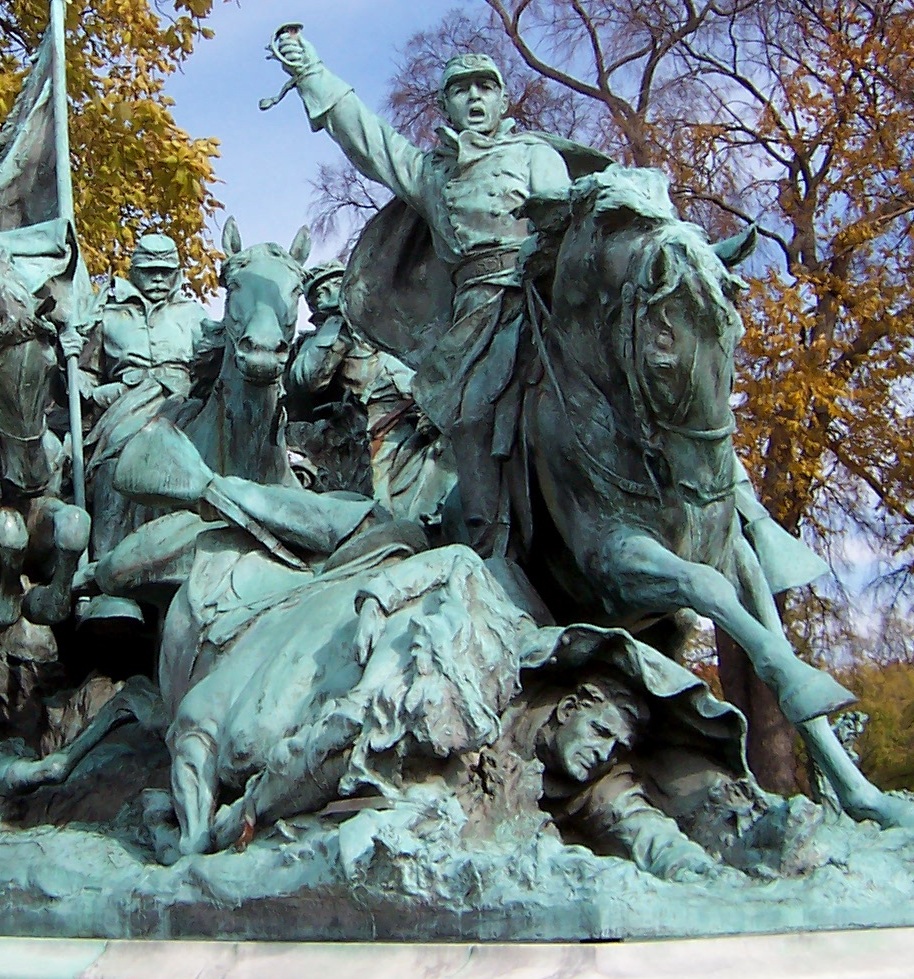
Washington, DC is filled with monuments.  Prominently at the foot of Capitol Hill is the Ulysses S Grant Memorial.  The general in his cavalry hat and overcoat astride his horse gazes over the battlefield of the Civil War.  Below him are steps leading to a reflecting pool.  Behind, the Capitol dome. 
It is, of course, a perfectly designed stage for large groups of students to have a group photo.  Seat of power of the present in the background; reminder of a troubled past right behind them. 

General Grant is flanked by two lower pedestals, each adorned by a male lion resting atop the spear-pointed staff of a guide-on, the battle flag of an army that is now lying on the ground under the paw of the lion.  Army of the Confederacy, perhaps?    

The lions are in turn flanked, right and left, by two lower and much longer bronze sculptures.  To the right as one views the Capitol, a team of four horses at a gallop is hauling a cannon on its gun carriage.  The soldier riding on the carriage and driving the horses is hunched over, head down, attempting to stay seated during the spine crushing bumpy ride.  

The horses' hooves bespeak the chaos of intelligent, magnificent animals, themselves caught up in the fog of war and obediently doing the bidding of their human masters engaged in frightening explosions of cannon, unspeakable bloodshed.  

I'm reminded of one recent artist's statement on an exhibit of work based on the imperial conflicts of World War I.  The artist's research found that something close to 20 million horses died in World War I.  Horses, just horses...

On the opposite flank of General Grant are more charging horses, this time the cavalry instead of the artillery.  The squad leader with raised sword that has lost its blade leads the others in the yell of the charge:  straight into enemy rifle and cannon fire, swords and fixed bayonets.  

About to be crushed beneath it all is one cavalyrman whose horse has either stumbled or been shot.  His eyes are open.  Both are about to be trampled, possibly causing another horse to stumble and break a leg.  

They shoot horses, don't they?

It's ironic.  The sunshine was so bright that I didn't even see the face of the fallen rider and his horse until I returned home and reviewed my photos.  

I hope the students noticed.  I hope he shows up in some of their photos.  But at least they were there and had a chance to see.  


Remember, we weren't defending our country from a foreign invader.  We were at war with each other, not really over states' rights but over the understanding of the definition of a human being.  

I can only hope for more Living History Days.  And I hope that when we look at the memorials we build to human failings, we let more than historians and politicians speak.  I hope we also let the artists and the prophets speak, too.  I hope we can still hear them.  

They might see the face of that man who fell with his horse.  They might help us ask the question, "What happened to both?"  If that soldier suffered a broken leg or a puncture wound, what were his chances of surviving the amputation and the gangrene?  Without anesthetic and antibiotics?  Did he fare any any better than his horse?     

And what did that contribute to our understanding of what a human being is?  And why?  

Living History Day.  I hope one happens near all of us soon.

Pastor Roger

Saturday, December 8, 2012

Welcome to the White House

Welcome to the White House.  Or not..

The welcome mat is out on Pennsylvania Avenue.  There is ample seating in the form of double benches just waiting for high ranking dignitaries, heads of state and admiring tourists to come take a load off.

The nicely rusted cast iron frame gives it a rather authentic early American look, don'tcha think?  Neat part is the area beneath for stowing your luggage.  Nice touch.  But do be careful when sliding over to chat with the person next to you.  Splinters could do you in.  

I'm not sure who was president when these benches were installed or last repaired.  I didn't go looking for a ratty example in order to make an erroneous general case.  All the benches looked like this one, pretty much...  No irony intended.  

Pennsylvania Avenue.  Capitol Hill in full view.  Up there in its splendid isolation behind its green plastic fence.  Hiding in plain sight behind AREA CLOSED signs.  

Obviously, there is another population that knows these streets when the limos and Chevrolet Suburbans and Ford Explorers with bulletproof glass are parked for the day.  

I like the KENNEDY fire hydrant cast in Elmira, New York.  I wish another Kennedy who once traveled Pennsylvania Avenue were here to see and offer some wisdom.  Wouldn't actually make much difference which Kennedy.  Almost any Kennedy would do today, methinks...

On my way back to the west end of the National Mall, I passed another one of those concrete planters, this one adorned by the ironic cast-offs of casual visitors.  Which one was actually the "transient" here?  Makes one wonder. 

Again, that question of what visitors to our country might see if they were on foot and taking it all in for the first time. 

Nowhere did there seem to be such a mixed message as the Constitution Avenue entrance to the Ellipse, that large lawn with the oval-shaped drive between the White House and the Washington Monument.

Why, for God's sake, is a LAWN off limits without an appointment?  The White House to the north is across Pennsylvania Avenue and surrounded by its own iron fence and high level security patrol. 
Could we do a tackier job of saying:

"Get Out.  Keep Out.  Stay Away.  You Don't Belong Here?"  

My country, 'tis of thee, sweet land of liberty, Of thee I sing...   

I pray for a resurgence in American pride.  Pride that manifests itself in humility and cooperation.  Humility that rests on the confidence that our system and high ideals actually lead to more security, more tranquility, more peace than hiding behind the barricades of fear.

We raised our daughter to be a whole person by treating her like one--even when she wasn't one yet.  Why are we surprised that when we treat the rest of the world like enemies and terrorists the world seems to respond in kind?  

Leviticus, Jesus, Apostle Paul and YHWH all agree:

1)  Love God above all.  2)  Love neighbor and self in equal measure.  There is no such thing as a one-sided coin.

Now, where was that WELCOME mat I last saw years ago?  Does anyone remember seeing it around here?  I kinda miss it these days. 

Shalom,
Pastor Roger